



Why Vacation Rental Doors Are Targeted by Intruders
Securing vacation rental property doors starts with understanding what makes them a target: long vacancy windows, unfamiliar guests cycling through, and entry doors built for residential privacy, not repeated forced-entry attempts. The pattern is consistent: a door that sits unwatched for weeks can be attacked without interruption.
Most break-ins aren't sophisticated. They're fast. A single kick near the lock area or a pry at the strike plate defeats a standard residential door in seconds, because the door isn't the weak point. The frame is.
Three factors make rental doors especially vulnerable:
- Extended vacancy. No one hears a failed attempt, so intruders can try again.
- Predictable turnover. Cleaners, guests, and contractors all hold keys or codes.
- Deferred maintenance. Loose hinges and worn strike plates go unnoticed between bookings.
The FBI crime data on burglary methods consistently shows forced entry is the most common method of residential burglary. For hosts, that means the door itself deserves the same attention as the Wi-Fi and the welcome basket.
Smart Locks and Remote Access Control for Vacation Rental Doors
Smart locks solve the key handoff problem, but introduce a new one: a deadbolt is only as strong as the frame it sits in. A keyless entry system lets you issue and revoke codes remotely, track arrivals, and eliminate the lost-key scramble, genuinely useful for property management at distance.
What most hosts miss is that a smart lock changes the lock, not the door. An intruder who kicks the door doesn't care how the deadbolt is operated, so pair remote access control with physical reinforcement.
A practical setup looks like this:
- Install a smart deadbolt with audit logging and unique codes per guest.
- Set codes to expire automatically at checkout.
- Reinforce the strike plate and jamb so the bolt resists force.
- Keep a mechanical key backup for outages and lockouts.
Remote access is convenience. Reinforcement is protection. You want both.
Physical Door Reinforcement: Deadbolts, Strike Plates, and Door Frames
The most common mistake with rental door security is upgrading the lock and ignoring the frame. A deadbolt throws into a strike plate held by two short screws. Under a hard kick, that plate tears out of the softwood jamb and the door swings open, lock intact.
Physical reinforcement targets the lock area, hinges, and frame. Steel plates and jamb shields distribute force across a wider area so a kick can't concentrate stress on a single point, where a purpose-built system beats generic hardware.
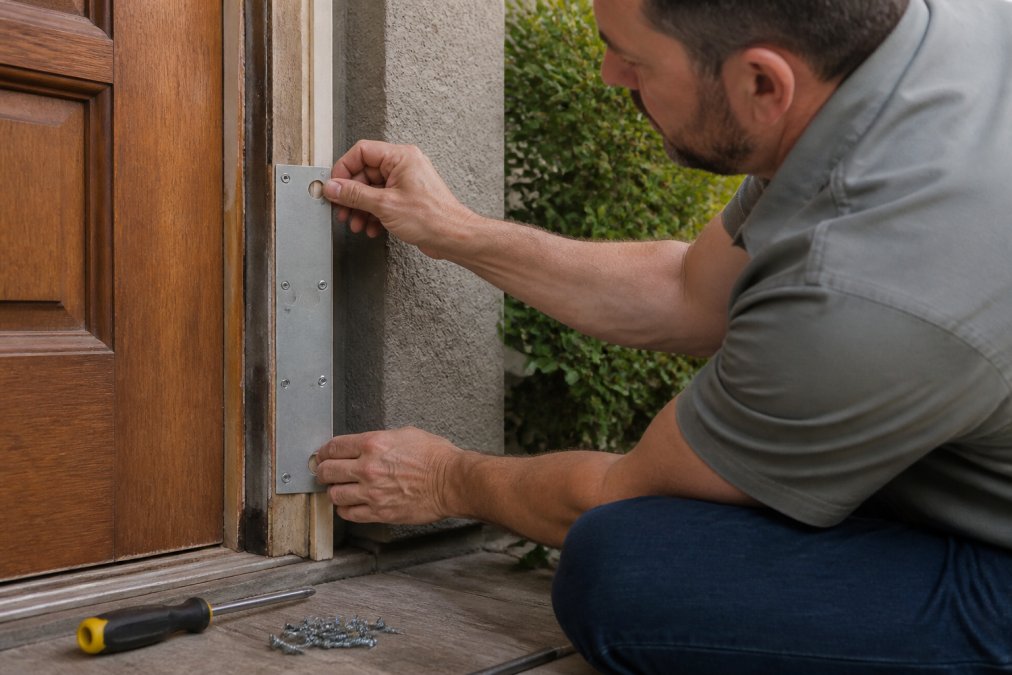
Close-up of a homeowner's hands installing a galvanized steel door reinforcement plate on a wooden exterior door frame, with a screwdriver and hardware on the floor nearby
Door Armor's patented galvanized steel system reinforces the lock, hinges, and frame together, and it's police tested and recommended. Installation takes under 30 minutes with basic tools, and the kit carries a $500 Lifetime Guarantee against kick-ins. The design matches your existing hardware, so a rental doesn't start looking like a fortress.
Pro Tip: Check your strike plate screws first. If they're under an inch long, the plate is held by little more than the trim. Replacing them with longer screws is the cheapest single upgrade you can make before adding plates.
Best Door Security for Renters: Non-Permanent Options That Work
The best door security for renters is hardware that reinforces the door without permanent modification, so it comes with you when you move. Renters and hosts face the same constraint from opposite sides: you can't tear out a jamb you don't own.
Non-permanent options that hold up:
- Door reinforcement plates that screw into the existing frame and can be removed and patched at move-out.
- Portable door locks that jam the door from the inside without tools.
- Door stoppers and wedges for secondary interior doors.
- Sliding door deadbolts that lock the panel to the track without drilling the glass.
For rental hosts, the calculus differs: you own the property, so permanent reinforcement is on the table and protects the asset between guests. A sliding glass door is a frequent gap, the Armor Latch Sliding Door Deadbolt, at $39.99, locks the panel to the track so it can't be lifted out.
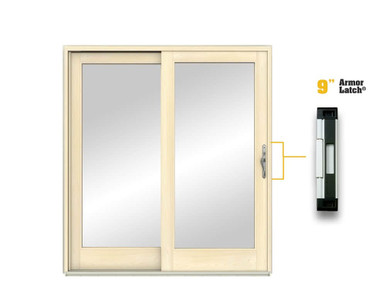
Armor Latch Sliding Door Deadbolt
Watch Out: A chain or a peephole is not security. A door chain fails under any real force, and a peephole tells you who's there after they've already reached the door. Treat both as awareness tools, not barriers.
Portable Door Locks for Travel: What Guests Should Carry
Portable door locks for travel give guests a second layer of defense in hotels, rentals, and unfamiliar rooms, and they're small enough to live in a carry-on. They work by bracing the door from the inside, so it can't be opened even with a key or code, but not all portable locks work the same way, and the differences matter when a door is actually pushed on.
There are three mechanical families, and each fails differently:
- Jamb braces (door jammers). A metal fork or paddle slides into the strike-side gap and wedges against the jamb. These resist inswing force well because the load transfers into the frame rather than the lock. They fail when the door gap is too wide, when the jamb is hollow metal, or when the door swings outward.
- Surface-mounted barricades. A plate with a folding arm anchors under the handle or into the strike plate and props against the floor or door face. These are strong on solid-core doors and weak on hollow-core hotel doors, where the anchor point can crush.
- Wedge and stopper devices. Rubber or polymer wedges jam under the door leaf. These stop casual entry and slow a determined push, but they rely on floor friction and slide on smooth tile or low-pile carpet.
What to look for before you buy:
- No tools required. It should set up in seconds after a long flight.
- Fits standard doors. Check the door gap (most devices need 1/8 to 1/4 inch) and door thickness before you buy.
- Works with inswing doors. Most hotel and rental doors swing inward, so confirm the device is rated for that direction.
- Packs flat and clears TSA. A device that looks like a weapon or a tool can be pulled at security; simple wedge and brace designs travel without issue.
- Leaves no marks. Adhesive or screw-based devices can trigger damage fees from a host or hotel.
A portable lock is a guest-side tool, not a substitute for host-side reinforcement, and it does nothing for the most common rental entry point: a sliding glass door, which has no jamb to brace against. Hosts who reinforce entry points give guests a safer room before they unpack; guests who carry a portable lock add a layer the host can't provide, a delay, not a guarantee.
Watch Out: A portable lock only works while someone is inside the room. It does nothing when the unit is vacant, which is exactly when rental doors are most often attacked. Hosts cannot outsource door security to a guest's carry-on.
For hosts, the practical takeaway is to mention in the welcome guide which doors are reinforced and which are not, so guests don't assume a portable lock is covering a gap the property already left open.
Vacation Rental Security Checklist: What to Inspect and Upgrade
A vacation rental security checklist turns vague worry into a repeatable inspection you run between bookings. Walk the property the way an intruder would, then fix what you find.
- [ ] Test every exterior door for frame movement when pushed.
- [ ] Confirm deadbolts throw fully into the strike plate.
- [ ] Check strike plate and hinge screws for length and tightness.
- [ ] Inspect sliding doors for track lift and add a deadbolt.
- [ ] Verify all entry points are covered by lighting and motion sensors.
- [ ] Review smart lock codes and revoke expired guest access.
- [ ] Confirm lockbox codes are changed after each contractor visit.
- [ ] Check window locks and any ground-floor access.
- [ ] Document the inspection date for insurance purposes.
| Weak Point | Fix | Why It Matters |
|---|---|---|
| Strike plate | Steel reinforcement plate | Stops kick-ins at the lock |
| Door frame | Jamb shield | Prevents frame splitting |
| Hinges | Hinge shields | Blocks pin removal and prying |
| Sliding door | Track deadbolt | Stops panel lift-out |
| Key handoff | Smart lock with codes | Ends lost-key risk |
Run this after every turnover. It takes minutes and catches the failures that only show up under force.
Cybersecurity, ADA Compliance, and Insurance: What Most Hosts Miss
Three issues sit outside the hardware aisle, and they're where most hosts get caught. Most guides stop at the deadbolt; hosts who avoid claims, fines, and lockouts treat the smart lock as a networked device, the door as an accessibility surface, and the reinforcement as an underwriting input.
Smart lock cybersecurity: the door you can't see
A keyless deadbolt is a small computer with a radio. The physical bolt may hold under a kick while the credential layer is wide open. The recurring failure patterns are consistent across brands:
- Default admin credentials. Factory codes like 1234 or a printed master PIN are published in manuals and never changed. Anyone who knows the model can try them.
- Unpatched firmware. Lock vendors ship updates for pairing flaws and replay attacks. A lock that has never been updated is running the version attackers already studied.
- Weak guest-code hygiene. Reusing the same code across turnovers, or leaving codes active after checkout, turns a convenience feature into a shared secret.
- Unencrypted or poorly paired hubs. If the lock talks to a hub or app over an unsecured channel, a nearby device can capture the handshake.
- No audit review. Audit logs only help if someone reads them. A code used at 2 a.m. on a vacant night is a signal, not noise.
A practical hardening routine:
- Change the default admin and master codes on day one.
- Enable two-factor authentication on the lock's app account.
- Apply firmware updates on a schedule, not when something breaks.
- Issue unique, auto-expiring codes per guest and revoke them at checkout.
- Review audit logs after every turnover.
- Keep a mechanical key backup in a secure lockbox for outages, and change that lockbox code after every contractor visit.
ADA compliance for door hardware
The ADA Standards for Accessible Design set requirements for door hardware on accessible routes, including operable parts and opening force. Two details trip up reinforcement installs:
- Operable parts. Handles, pulls, and latches on accessible doors must be operable without tight grasping, pinching, or twisting of the wrist. A reinforcement plate that changes the shape or clearance of the handle can push a compliant door out of compliance.
- Opening force. Interior hinged doors on an accessible route have a maximum opening force. Adding steel plates, jamb shields, or a heavier deadbolt can increase the force needed to open the door. Measure before and after.
If you advertise an accessible unit, check the standards before you install on that entry, and document the pre- and post-install measurements. A reinforcement kit that improves security on a standard door can quietly break an accessible one.
Insurance implications of security choices
Many policies require working locks and may reduce or deny a claim if entry was through an unsecured or inadequately maintained door. The Insurance Information Institute guidance on home security notes that security improvements can factor into coverage and premiums. What underwriters and adjusters actually look for:
- Working deadbolts on all exterior doors, including sliding doors.
- Proof of maintenance, dated inspection records, not verbal assurances.
- Documented reinforcement, photos of installed plates, jamb shields, and hinge shields.
- Access control records, smart lock audit logs showing codes were revoked at checkout.
- Consistent security across the property, since a single unreinforced door can be the entry point a claim hinges on.
Keep a simple security file: inspection dates, hardware photos, lock model and firmware version, and code-revocation logs. If a claim is ever questioned, that file is the difference between a payout and a dispute.
Seasonal security adjustments
Risk shifts with the calendar. High-season occupancy means more foot traffic, more codes in circulation, and more wear on strike plates and hinges. Off-season vacancy means long unwatched windows, exactly when a failed attempt goes unheard and an intruder can try again. Adjust accordingly:
- High season: shorten code lifespans, inspect strike plates and hinges more often, and confirm every turnover revokes prior access.
- Off season: verify lighting and motion sensors still trigger, check freeze-prone locks and hardware, and consider a physical walk-through on a schedule rather than only between bookings.
- Storm season: confirm sliding-door track deadbolts and exterior hardware are seated and not loosened by temperature swings.
Key Takeaway: Hardware, software, and paperwork are one system. A reinforced door with a default-password smart lock, no firmware updates, and no inspection record is still a liability, and on an accessible entry, it can be a compliance problem too.
Frequently Asked Questions
What are the best door locks for a vacation rental property?
The best setup combines a smart lock for remote access control with physical reinforcement hardware. Smart locks let you change codes between guests without a locksmith, while steel reinforcement kits protect the door frame and strike plate from kick-ins. For sliding glass doors, a dedicated deadbolt such as the Armor Latch Sliding Door Deadbolt ($39.99) prevents the door from being lifted off its track. Pair digital access with physical reinforcement so a failed battery or hacked code never leaves the property exposed.
How do I secure a vacation rental door without permanent modifications?
Renters and hosts who cannot drill into the frame have several options. A portable door lock that inserts into the strike plate requires no tools and can be removed in seconds. Door bars and lock stoppers wedge under the handle for temporary reinforcement. For a more permanent but reversible solution, Door Armor kits install with screws into the existing frame. Check your lease or HOA rules before any installation that leaves screw holes.
Are there legal restrictions on changing locks in a vacation rental?
Laws vary by state and municipality, but most short-term rental regulations require hosts to provide guests with a working lock and a safe means of egress. Some jurisdictions require specific lock types, such as deadbolts with a minimum throw, or mandate that smart lock codes be changed between stays. If you rent rather than own, your lease may prohibit permanent lock changes. Review local ordinances and your rental agreement before replacing or adding locks, and always keep a mechanical key backup accessible for emergencies.
How do you balance guest convenience with property security?
Use a smart lock with unique, time-limited codes for each guest so access is easy but traceable. Add physical reinforcement that works silently in the background, such as a reinforced strike plate and hinge shields, so guests never have to think about security. Keep a lockbox with a mechanical backup key for cleaners and emergency access, and change its code regularly. This layered approach means guests get a simple check-in while the property stays protected against forced entry.