


Burglary Statistics for Homeowners: What the FBI and BJS Data Show
By Ifunanya Aniebonam
You'll find plenty of burglary "facts" online. Many have no source, and some get repeated until they sound true. This page sticks to two federal sources, the FBI's crime reporting program and the Bureau of Justice Statistics' National Crime Victimization Survey (NCVS), and shows the year next to every number.
Every figure links to its source. Where we did the math ourselves, we say so.
Homes are the main target
In 2019 the FBI estimated 1,117,696 burglaries nationwide, and burglaries of residential properties accounted for 62.8% of all burglary offenses (FBI UCR, 2019). Put simply, most burglaries happen at someone's home.
Owning your home doesn't make you immune
The BJS report Household Burglary, 1994–2011 found that in 2011 there were 18.3 completed burglaries per 1,000 owner households, compared with 32.7 per 1,000 renting households (BJS, 2013). Owners are burglarized less often than renters, but by our arithmetic 18.3 per 1,000 is still roughly 1 in 55 owner households in a single year.
Most burglaries involve force
In the FBI's 2019 data, 55.7% of burglaries involved forcible entry, 37.8% were unlawful entries (no force), and 6.5% were attempted forcible entry (FBI UCR, 2019). Together, about 62% involved force or an attempt at it (our arithmetic).
What that means for you:
- Force is the most common way in. At a front door, force often means a kick. The deadbolt holds, but the wood jamb around the strike plate splits. A lock is only as strong as the frame it's screwed into.
- Lock up anyway. More than a third of burglaries in 2019 were unlawful entries without force. Locking the deadbolt every time, including when you're home, closes that door.
The cost, and the odds of getting it back
- The FBI put the average dollar loss per burglary at $2,661 in 2019, with about $3.0 billion in total property losses (FBI UCR, 2019).
- BJS found that only 58% of completed household burglaries were reported to police in 2011, and about 10% of reported burglaries led to an arrest (BJS, 2013).
The $2,661 is stolen property. It doesn't count a broken door frame, a new lock, or the time off work to deal with it.
How to use these numbers at your own door
If most burglaries involve force, and recovering what's taken is unlikely, the best place to spend is on stopping the break-in. Cameras and alarms record and alert. A reinforced door physically resists the kick.
Start with our complete guide to kick-proofing a door. In short:
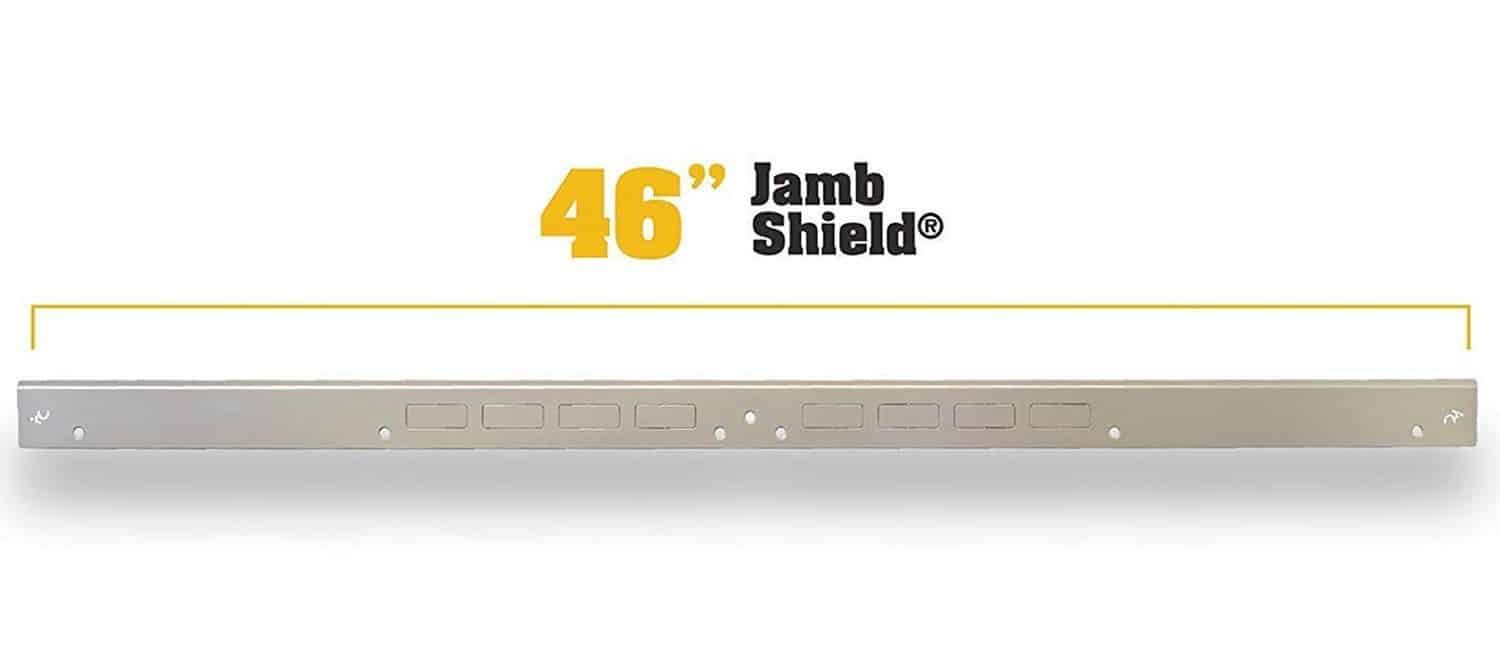
- Reinforce the jamb. A full-length steel jamb shield spreads a kick across the frame instead of a few inches of wood at the strike plate.
- Protect the door around the lock. Door shields wrap the lock area so the door itself doesn't split.
- Add hinge shields if your door swings in and the hinge side is weak.
- Lock the deadbolt. Every time.
Door Armor does steps 1 and 2 in one kit, and hinge shields are available as an optional add-on for step 3. It's Made in the USA, installs with a drill in about 30 minutes with no door replacement, and also works on new construction. If your frame has already been kicked in, it needs repair, not just reinforcement. That's the job of FIX-A-JAMB; see our guide to repairing a kicked-in door frame. FIX-A-JAMB and Door Armor aren't installed on the same door; it's one or the other.
Every single-door kit carries our lifetime kick-in guarantee: $500 on Door Armor MAX kits and $300 on Door Armor MINI and MINI PLUS kits, for as long as you own the home. It covers kick-ins, not battering rams or prying tools. Double-door kits aren't covered by the guarantee. Shipping is free on orders over $99 to the lower 48 states, and you have 60 days to return a kit.
Own rental property? See our rental property burglary statistics for property managers.
Frequently asked questions
How common is burglary in the U.S.?
The FBI estimated 1,117,696 burglaries in 2019, and 62.8% of burglary offenses were at residential properties.
How do most burglars get into a house?
In the FBI's 2019 data, 55.7% of burglaries involved forcible entry and another 6.5% were attempted forcible entry. 37.8% were unlawful entries without force, such as through an unlocked door.
Are homeowners less likely to be burglarized than renters?
Yes. BJS found 18.3 completed burglaries per 1,000 owner households in 2011, compared with 32.7 per 1,000 renting households.
What's the average loss from a burglary?
The FBI reported an average loss of $2,661 per burglary offense in 2019.
How many burglaries are solved?
BJS found about 58% of completed household burglaries were reported to police in 2011, and about 10% of reported burglaries led to an arrest.
Why aren't these statistics from this year?
They're the most recent primary-source figures we could verify for these specific breakdowns. We show the year next to each one rather than relabel older numbers as current.
Kick-proof your door
Shop the Door Armor Single Door Kit · Read the kick-proof door guide.